
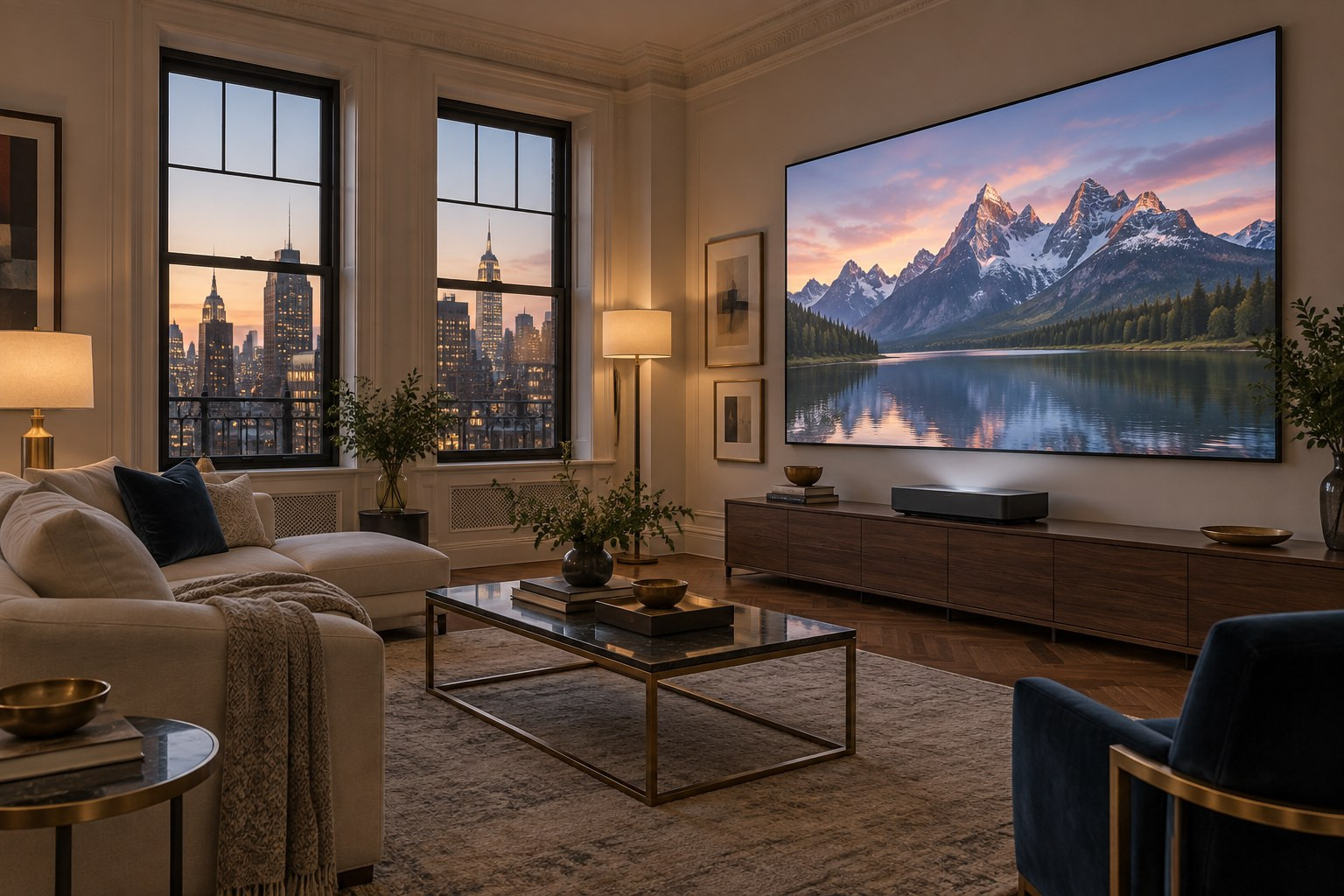
Ultra Short Throw Projector vs. Big TV: Which Is Right for a Manhattan Living Room?
An ultra short throw projector gives you a 100 to 120 inch image from a box that sits on a console a few inches from the wall. A big screen TV (85 to 98 inches) gives you a brighter, sharper image that looks good with the lights on. In a Manhattan living room, the projector wins on size, on getting through the door, and on how the space looks when it is off. The TV wins on brightness, black levels, and daytime viewing. Prices overlap: a good UST projector with a screen runs $5,000 to $14,000 in equipment; a 98 inch TV runs $2,000 to $15,000 depending on the panel.
⚡ QUICK SUMMARY
UST projector: 100 to 150 inch picture, sits inches from the wall, needs an ambient light rejecting (ALR) screen to look right. Projector $2,800 to $6,000, screen $2,000 to $6,000 (MSRP). Big TV: 85 inch from about $1,200, 98 inch from about $2,000, up to $15,000 for a flagship. Brighter than any projector, no screen needed, but a 98 inch TV weighs about 145 pounds and may not fit in many elevators. Pick the projector for movie nights and clean design. Pick the big screen TV for sports with the shades up.
Most people want a bigger image these days. Ten years ago that meant a projector in a dark basement or home cinema. Today you have two real choices for a living room: an ultra short throw (UST) projector, sometimes called a laser TV, or a very large TV. We install both in Manhattan apartments. Here is how to choose, with published prices and the trade-offs nobody puts on the box.
Home Theater Advisors has installed home theater and audio-video systems in New York City since 2011, with over 500 installs across Manhattan, Brooklyn, Queens, and Central New Jersey. We do not have a favorite between projectors and TVs. We have a favorite for your room, and this guide shows you how we get there.
What Is an Ultra Short Throw Projector?
An ultra short throw projector sits on a low cabinet a few inches from the wall and throws the image up and out. A throw ratio around 0.22 means a 100 inch image from roughly 9 inches away. Most use a laser light source rated for 20,000 hours or more, so there is no bulb to replace. The current models run Google TV or a similar smart platform, so they stream on their own, just like smart TVs do. The tech has come a long way in recent years, and the benefits are real if the setup is right.
CNET's 2026 buying guide sums up the catch: UST projectors have some of the highest lumen ratings of any projector type, but they still need a screen to look right, because of how they throw light. The "just replace your TV" pitch skips that part. Plan on the screen.
Ultra Short Throw Projector vs. TV: The Side by Side
Equipment prices are manufacturer and retailer list prices in 2026, before installation. NYC labor runs higher than national averages. We charge MSRP on any equipment we supply.
How Much Does a UST Projector Cost in 2026?
Here are published prices for three projectors we get asked about most, plus the screens that pair with them.
In TechRadar's review, the Hisense PX3-Pro is rated at 3,000 lumens. Epson rates the Lifestudio Grand Plus at 4,000. The Epson is the brightest of the three, which is why we point sports fans with south-facing windows toward it. It also has a better throw ratio, so the projector sits closer to the wall without giving up screen size. The Samsung costs twice as much as the Hisense and buys you a little more brightness and color, not twice the picture.
💡 Pro Tip: Ignore the Lumen Number on the Box
Lumen ratings on the box are marketing. CNET measured a projector rated at 3,000 lumens and got about 1,280 in its most accurate picture mode. Judge a projector by how it looks in your light, not by the spec sheet, and, of course, sit where you will actually sit. That is why we bring a demo unit to the apartment when we can.
How Much Does an 85 or 98 Inch TV Cost?
Big TV prices fell hard in the last two years. Mini-LED sets from TCL and Hisense now sell 98 inch screens for what a 75 inch cost in 2023. The premium brands still charge premium money for the same size. One note: the TVs below are listed for price reference only. We do not carry TCL. We will recommend a TV from the brands we do carry and price it at MSRP.
Street prices shown for size comparison. We do not sell TCL TVs.
A TV beats a projector on raw picture quality in a bright room, and it is not close. Mini-LED sets hit 2,000 to 5,000 nits of peak brightness. A projector on a 120 inch screen delivers a small fraction of that. With the shades up at noon, the TV looks like a window. The projector looks washed out unless the screen is doing serious work.
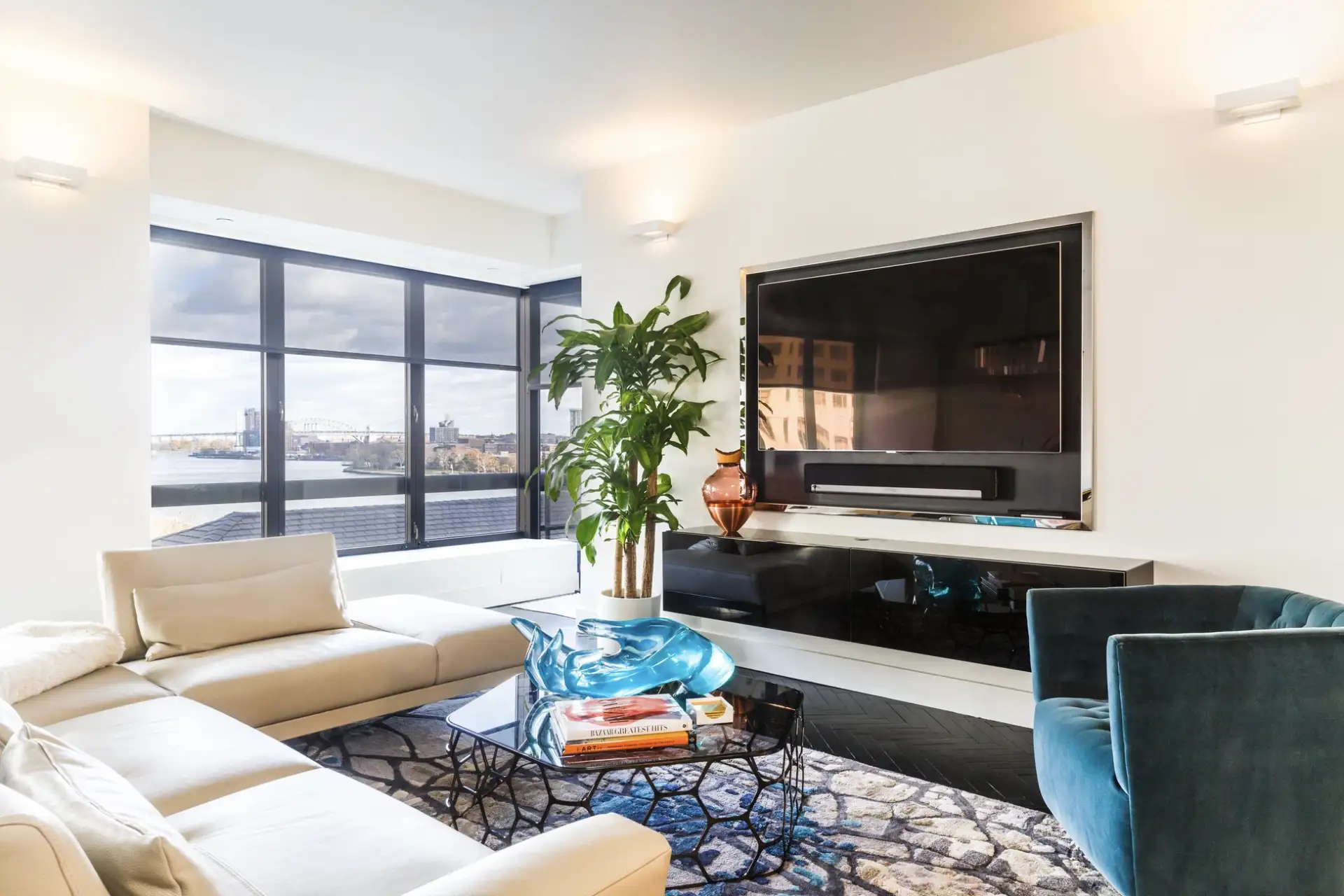
A large TV recessed into custom millwork in a Manhattan apartment, wires hidden, soundbar built in
Why Manhattan Changes the Answer
In a suburban house, the TV usually wins on value. In a Manhattan apartment, four things push many of our clients toward the projector. If you are wondering which way to go, start here.
What matters in a NYC apartment
The elevator and the stairs - A 98 inch TV is about 7 feet wide and 145 pounds in the box. Pre-war buildings with small elevators or tight stair turns may not get it upstairs. A UST projector comes in a box you can carry. The screen still has to get upstairs, though, so we check that too. Many service elevators have a hatch in the ceiling that opens so long items can ride up.
The wall it hangs on - Plaster over metal lath, poured concrete, and modern metal-stud walls with glass or marble each need their own mount and anchor plan. A 145 pound TV on a plaster wall needs blocking or a heavy-duty mount into structure. A projection surface weighs a fraction of that.
The way the room looks - Most of our clients want the space to feel like a home first. A framed ALR screen reads like art, and a floor rising UST screen disappears completely when it is not in use. A 98 inch black panel does not disappear.
Light control - Manhattan windows are big and often face other windows. If you already have or plan motorized shades, a projector works all day. If the shades are staying up, buy the TV.
One more Manhattan fact: media rooms here are living spaces, dens, and second bedrooms. We have built one true theater room in Manhattan in 15 years. Everything else is a shared space that has to look good at 2pm with guests over. Design your setup for that.
Not sure which way your room leans? We will look at the wall, the light, and the elevator, free.
Book a Free ConsultationPicture Quality: Where Each One Wins
Projector wins: size and immersion. A 120 inch image is more than twice the area of an 85 inch TV. Movies, concerts, and the big game feel different at that scale. The viewing experience is closer to a home cinema than a living room. Laser UST models also handle color well; the triple laser units cover nearly all of the wide DCI-P3 color range.
Big screen TV wins: brightness, contrast, and sharpness up close. OLED gives you true black. Mini LED gives you HDR highlights that pop. Text and sports graphics are incredibly sharp. And there is no screen surface to add texture or sparkle. Performance in a bright room is simply better.
Wirecutter tested an ALR screen against a plain white screen with the lights on. On the white screen the image was washed out. On the ALR screen it was completely watchable, with a big jump in contrast. That is the whole case for spending on the screen.
⚠️ Skip the Screen and You Will Regret It
Do not project onto a painted wall and expect the showroom image. The wall has texture, the paint is not neutral, and every ceiling light lands on it. The ALR surface is not an upsell. It is the part that makes a UST projector work in a real living room.
Installation: What Each One Needs Behind the Wall
Both options need power at the right spot, an HDMI path to your sources, and a plan for sound. The details differ.
1UST projector
A console or credenza at the right height and distance, a level ALR surface, power and HDMI to the console, and a soundbar or in-ceiling speakers. The tricky part is alignment: the surface and projector have to be square to each other within a fraction of an inch. Fishing wire in plaster or concrete almost always means holes; we do not patch or paint, so plan for a painter.
2Big TV
A mount rated for the weight, anchored into structure, a recessed power outlet and HDMI conduit behind the panel, and either a soundbar or a full surround system. In concrete, that means drilling and often a surface chase hidden by millwork. In plaster, that means finding the lath and the studs first.
3Either one
Motorized shades and lighting scenes make both look better. One button drops the shades, dims the lights, and starts the movie. See our guide to what Control4 actually does for how that works.
So Which Should You Buy?
Buy the UST projector if... You watch mostly at night, you want 100 inches or more, the room needs to look like a living room, or a big TV cannot get up the stairs. | Buy the big screen TV if... You watch sports and news in daylight, the shades stay up, you want the sharpest picture, and the building can deliver a 145 pound box. |
Consider both if... You have a large great room. Some clients put an 85 inch smart TV in the family area and a UST projector in a den. It is more common than you would think. Compare how you watch: sports and news by day, movies by night. | Budget check Projector plus screen plus a soundbar lands near $6,000 to $15,000 in equipment. A 98 inch Mini-LED plus soundbar can land under $4,000. Installation is extra and NYC runs higher than national averages. |
“I spent years watching great products get installed badly. The equipment matters - but the installer matters more.”
- Mark Feinberg, Founder of Home Theater Advisors
Common Questions About UST Projectors and Big TVs
Are ultra short throw projectors any good, or should I get a big TV?
Yes, they are good, but not in a bright room. In a dark or shaded room with an ALR screen, a good laser UST projector gives you a bigger, more cinematic picture than any TV. In daylight with shades up, a Mini-LED or OLED TV is clearly better.
How far from the wall does a UST projector sit?
Usually 6 to 15 inches from the screen, depending on the model and picture size. It sits on a console below the screen, so it takes the space a TV stand would take.
What are the disadvantages of a laser TV?
Lower brightness and contrast than a TV, a required screen, careful alignment, and fan noise on some models. The pros are size, a small box, and a clean wall when it is off. Laser light sources do not use lamps, so there is no bulb to replace.
Do laser projectors need bulb changes?
No. Laser light sources are rated for 20,000 hours or more, and there are no lamps to replace. At four hours a night that is more than 13 years.
Can a 98 inch TV fit in a pre-war elevator?
Sometimes. The box is about 7 feet wide. Measure the elevator cab, the door, and any stair turns before you order. Many buildings require the service elevator and a delivery window.
What size TV replaces a 100 inch projector picture?
Nothing under 98 inches comes close. An 85 inch large screen TV has about 72 percent of the area of a 100 inch image. Read our guide on how to choose the right TV size for your room before you decide.
Ready to see both in your own light? We bring the conversation to your apartment, measure the wall, check the elevator, and give you an itemized proposal with equipment at MSRP. Read our home theater installation cost guide first if you want the numbers, then book a free consultation.
About the Author
Mark Feinberg, Founder & CEO of Home Theater Advisors. Before founding HTA in 2011, Mark ran Product Management at ADI, one of the largest AV distributors in the country. He is a Certified Control4 Smart Home Dealer and CEDIA member, and HTA has earned multiple Houzz Best of Design Awards. Mark holds a BA from Dartmouth and an MBA from Duke's Fuqua School of Business. He lives in Manhattan with his family.
Big Picture, Right Choice
Projector or TV, we will tell you which one fits your space, your light, and your building. Free consultation, itemized proposal, Upper East Side based.
| Call (646) 450-1060 → | Book a Free Consultation |
